

We previously explored the challenges of working capital that many service businesses face. Now, we’ll dive deep into a critical aspect of working capital management: Accounts Receivable (AR).
We’ll answer questions such as:
- What specific practices set apart masterful AR management?
- How can I spark a sense of urgency for prompt payments in my business?
- What free resources can I use to supercharge my AR management?
- How do I improve AR without compromising critical relationships?
Efficient AR management isn’t just about ensuring you get paid; it’s about strategic improvements to cash flow that can fuel your growth.
We’ll walk you through tactics to refine your AR processes—from setting clear payment terms to leveraging the latest financial technology. Our goal is to help you turn what is often seen as a back-office function into a dynamic asset for your business.
Read on if you want actionable insights and tools to handle receivables better and pave the way for more predictable cash flow. Set the stage for a smoother, more efficient pathway that supports your expansion.


Clearly Communicated Payment Policies
A good payment policy includes three elements:
- Clearly defined payment deadlines
- A list of acceptable payment methods
- Explicit consequences for late payments
Ensuring clients and customers understand these terms before work begins is crucial to prevent misunderstandings and delays.
Do these policies need to be codified in your contracts? Of course. But if you want to take your AR management to the next level, take one extra step to articulate your policies in plain, engaging language in a separate document or email.
This approach elevates the routine task of understanding payment terms into a more engaging experience, ensuring customers and clients are fully informed. Clarity not only prevents disputes but also helps you maintain positive relationships.
Curious to see what an effective payment policy looks like? Check out our free Payments Policy Template. Download and customize it for your business. No email required.
Incentives for Prompt Payments
Encourage early payments to strengthen relationships and improve cash flow. For instance, consider offering a slight discount (1-3%) for payments made within a week of invoicing, and you’ll be surprised how many accounts take you up on it.
If you have concerns about the impact on profitability, consider implementing incentive discounts at the same time as your annual pricing review. For example, if you’re contemplating a 3% price increase, consider targeting a 4-5% increase to offset the cost of your new incentives. Focus your pricing increases and incentives on clients and customers who have historically been the least prompt in making payments.
Want to encourage timely payments from a value-added perspective rather than purely from a cost perspective? Offer non-monetary rewards, like access to premium services or prioritized capacity.
Remember, incentivizing prompt payments is not just about improving cash flow; it also strengthens relationships and contributes to your business’s overall financial health.
Tiered Payment Policies
One of the most common barriers to developing effective payment policies is that business leaders are understandably reluctant to treat all customers and clients the same. That’s where tiered payment policies can be a huge help.
Tiered payment policies involve sorting your clients or customers into different groups, each with its own payment terms. Based on factors like their payment history or size, each group gets terms that are more or less strict. This way, you can keep good relationships with your most established clients and customers while still managing your cash flow well.
Here are practical steps to implement tiered payment terms in your business:
- Start with stringent payment terms as the default for all clients or customers.
- Identify different client or customer segments based on their payment behaviour, size, and relationship with your business.
- Develop standardized payment terms for each segment. These terms should be more lenient than the default and vary based on the segment’s characteristics.
- Any deviation from the default payment terms must be approved by management.
- Regularly review and adjust these segments and their associated payment terms as necessary.
Sample Payment Tiers

By tailoring your payment terms to each segment’s unique needs and characteristics, you can maintain a strong relationship with your clients and customers while optimizing your cash flow and reducing your need for excessive working capital.
Simplifying Payments
Sometimes, late payments occur simply because the payment process for customers and clients is too complicated. Simplifying payments with pre-authorized debits and easy payment options can often reduce accounts receivable more effectively than any process or persistent follow-ups.
Pre-authorized Debits (PAD): This payment method allows businesses to debit bank accounts for services with prior authorization. PAD is particularly effective for recurring payments, such as monthly subscriptions or regular service fees, eliminating the need for clients or customers to initiate each payment manually. It’s a set-it-and-forget-it solution that ensures timely payments and reduces the administrative burden on both sides.
If you choose this approach, consider incorporating PAD in your service contracts as a standard business practice alongside your other terms. Some customers and clients may push back, but many will not.
Multiple Payment Methods: Offering more than one payment method, such as credit cards, wire transfers, ACH/EFT, and digital payments, can encourage more prompt payments. This approach accommodates the preferences of different customers and clients, expediting the payment process and leading to improved cash flow.
Online Payment Portals: These platforms enable clients and customers to view invoices, track payment history, and make payments securely online. Integrating with major credit cards and payment services ensures convenience for a wide range of businesses.
Embed Payments in Invoices: You don’t need to stop at providing payment instructions in invoices. Instead, consider embedding payments with a call to action in your invoice, making it simple for clients and customers to pay you immediately after reviewing the invoice.
When simplifying payments, remember that different payment methods may result in different transaction fees. For instance, a typical fee for credit card processing ranges from 1.5% to 3.5% of the total transaction. Some businesses offset these costs by charging more for transactions made via credit card or other payment methods that incur transaction costs. Each company is different. Some companies may find that the efficiency of credit card payments—quick online transactions, easier payment data integration, and fraud protection—makes it worthwhile to absorb these surcharges. Others, especially those with lower margins, may want to add a surcharge for credit card transactions or avoid them entirely.

Automated Invoice Delivery
Automation can simplify the early steps of invoicing, but it may not suit everyone. Many businesses rightly worry that too much automation can make communications seem impersonal. Often, people prefer a personal touch, especially when it comes to payments.
Take a balanced approach. Start by automating your invoice distribution.
Automating invoice distribution ensures you send out invoices promptly, reducing the likelihood of late payments due to delays inherent in manual processing.
When payments are overdue, shifting to personalized follow-up can make sense.
Here are some tools that effectively manage both automated invoice distribution and support personalized follow-up:
- Accounting Software (QuickBooks, FreshBooks, Xero, Wave): Your accounting software’s invoice functionality makes it easy to send invoices to clients and customers automatically, simplifies billing, and integrates invoices with your general ledger.
- Stripe: While primarily known for processing payments and its API, Stripe has an excellent invoicing product that allows you to include payment links and multiple payment options.
- Quoting Software (PandaDoc, Proposify): Automatically create and send invoices, contracts, and proposals from one interface and unified data. Integrate with other business systems to help your workflow.
- CRM Systems (Salesforce, HubSpot): CRM tools often have features or add-ons for automatic invoicing and billing within the sales and service processes, improving accuracy and communication.
Ultimately, automating invoicing complements effective AR management, simplifies payments, and aids in managing your service business’ working capital effectively.
Integrate Invoicing with Payer Systems
Integrating your billing system with your clients’ or customers’ accounting software, like QuickBooks Online or Xero, ensures your invoices automatically show up where they need to manage their finances. This integration eliminates the need for them to enter everything by hand, reducing mistakes and helping them pay you faster. It’s a win-win: your business fits smoothly into its financial routines, making life easier for both of you and speeding up your cash flow.
While it might not matter much if you mainly service individuals, this can be a valuable approach if you’re a B2B business, particularly for your largest clients or customers.
If that’s the case, this kind of setup is super practical. It saves time for your clients or customers and reduces the chances of payment delays because of lost invoices or entry errors. Essentially, it’s using smart tech to remove unnecessary steps to get paid faster.
The good part is that this isn’t just about making payments smoother. It also lets you and your clients or customers keep a close eye on where payments stand in real-time. This means fewer surprises and better relationships, as they’ll see you’re looking for ways to make their lives easier.
To get this rolling, you first need to figure out what accounting tools your clients or customers use the most and then pick a billing system that can easily connect with those tools. Nowadays, many billing systems are built to work well with popular accounting software, either directly or through automation software like Zapier.
In short, making your invoicing system talk directly to your clients’ or customers’ accounting software simplifies the payment process, makes you a more appealing partner, and builds trust by showing you value their time and profitability.
Weekly AR Review
A detailed weekly AR review is more than a financial checkpoint; it’s a strategic meeting that deserves the attention of your company’s top leadership.
In a weekly Accounts Receivable (AR) review, company leaders meet to assess and categorize unpaid invoices based on risk levels. This meeting helps prioritize collection efforts and identify potential issues that require immediate attention. The goal is to improve payment collection, maintain healthy cash flow, and ensure adherence to payment terms.
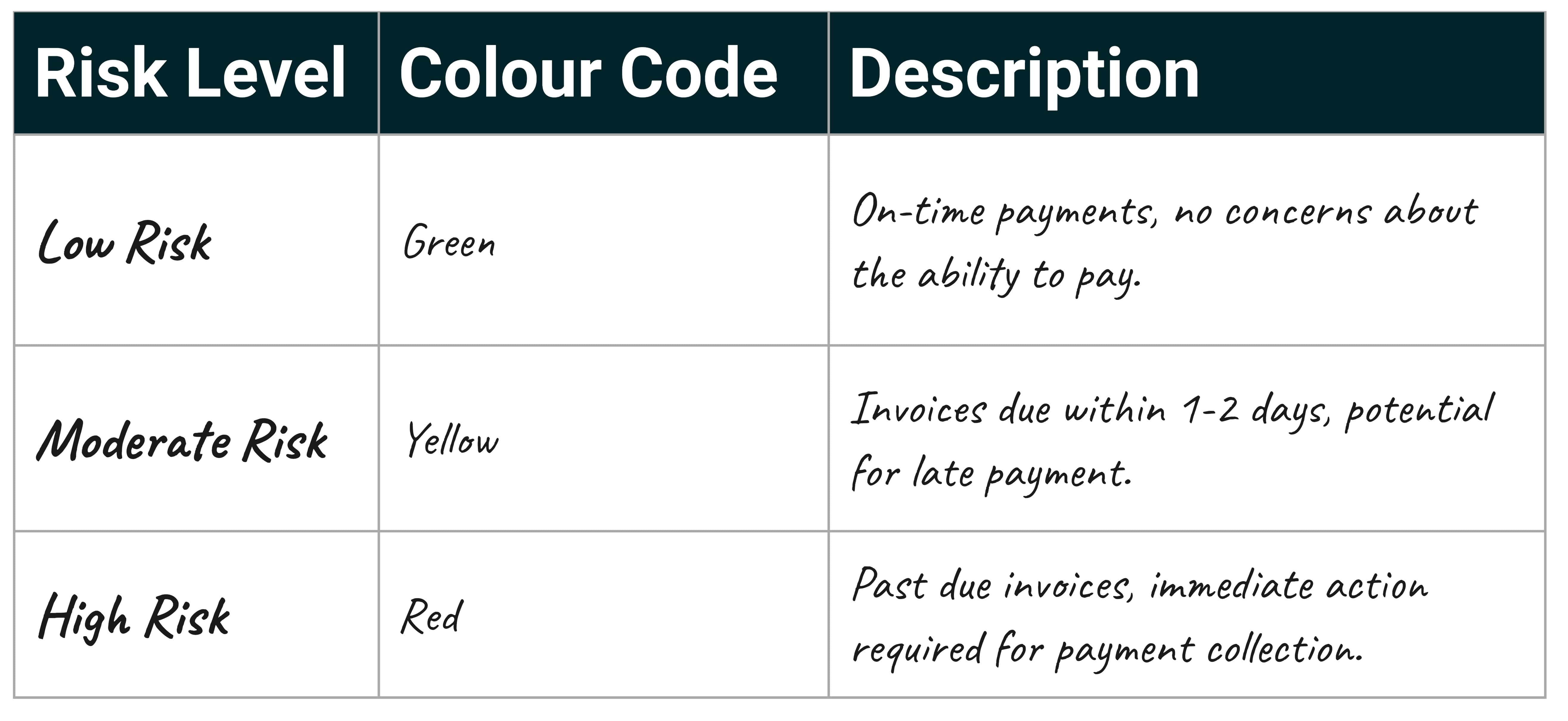
By categorizing outstanding invoices into risk levels—consider a system like ‘green’ for on-time payments, ‘yellow’ for invoices approaching due, and ‘red’ for past due—you prioritize your team’s efforts on collecting the most at-risk payments. For example, suppose you notice a large, otherwise reliable client or customer has slipped into the ‘red’ category. In that case, it might indicate a potential issue worth a direct follow-up call from the CEO or CFO. This level of attention not only aids in recovery efforts but also signals the importance you place on your payment terms.
AR Risk Levels:
Frequently reviewing your AR is essential because the more stale payments get, the less likely you’ll collect. Consider the CEO, President or COO running this meeting, making clear that it is essential to the overall business and not just finance. Generate a report a few days before the meeting so everyone can review the information in advance.
Use of Escrow Services
Using escrow services for larger projects can be a game-changer, particularly when dealing with significant transactions. This approach respects new customers and clients who may have valid concerns about paying you upfront. At the same time, it allows you to be in a stronger position if there is a dispute.
If you use escrow services, it’s best to use your law firm or service provider. Doing so allows you to maintain more control and benefit from superior service and lower costs due to obtaining escrow services at scale.
Here’s how setting up escrow services could work in your business.
You’re about to sign a contract for a six-month project valued at $100,000 with a new customer or client. To mitigate risk, you agree to use an escrow service managed by your law firm. You outline milestone payments within the escrow agreement, such as 30% upfront, 20% at the three-month mark, and 50% upon completion. This structure ensures funds are available and will be released as work progresses, providing security for both parties.
Escrow services provide an added layer of financial security for you and your clients or customers. They’re a valuable resource to manage financial risk, enhance trust and strengthen your relationships.
Assessing Creditworthiness
When assessing the creditworthiness of new customers or clients, combining traditional financial checks with modern data analysis can offer a comprehensive view.
Traditional checks include requesting and reviewing the last two years of financial statements and conducting a credit check through agencies like Equifax or Experian.
For a non-traditional approach, delve into the prospect’s online footprint. For example, a restaurant looking to contract your services might not have an extensive financial history if it’s relatively new. However, a vibrant online presence, high ratings on Yelp, and positive interactions on social media could indicate a healthy, thriving business.
This holistic approach to assessing creditworthiness allows you to make informed decisions, balancing financial data with real-world indicators of a company’s performance and reliability.
Empowering Your AR Management: Final Takeaways
Mastering Accounts Receivable management can supercharge your business’s cash flow, empowering you to grow and expand. By implementing clear payment policies, incentivizing prompt payments, simplifying payment methods, and regularly reviewing your AR, you can transform your AR management into a strategic tool for business growth.
Remember, the goal isn’t just to ensure you get paid. You’re also maintaining strong business relationships and strengthening your financial foundations.
Start implementing these practices today and watch cash show up in your business.